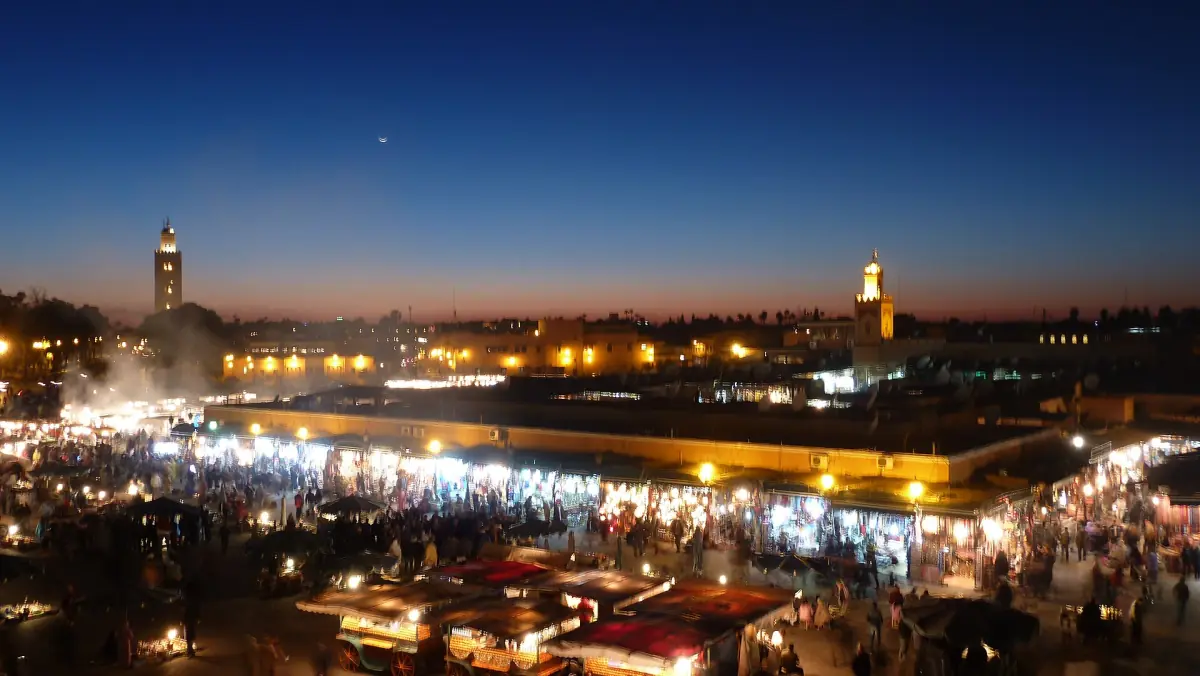
Jemaa el-Fna facts at a glance
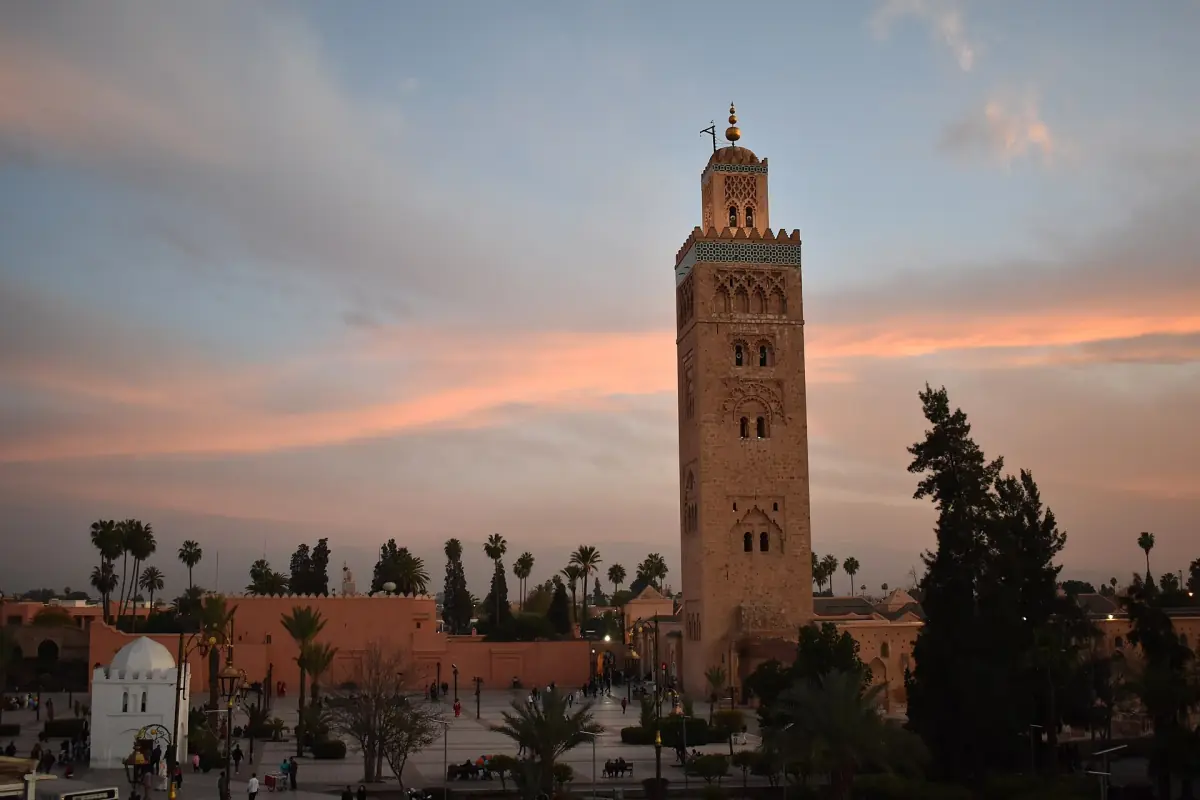
Jemaa el-Fna is a public square in the medina of Marrakech, just south of the main network of souks, with the Koutoubia Mosque to the west. Visiting the square is free. No ticket is needed, though rooftop terraces, guided tours and museums nearby charge their own prices.
UNESCO describes the square as triangular. For a walk with a local guide, see our overview of Marrakech food tours at Jemaa el-Fna.
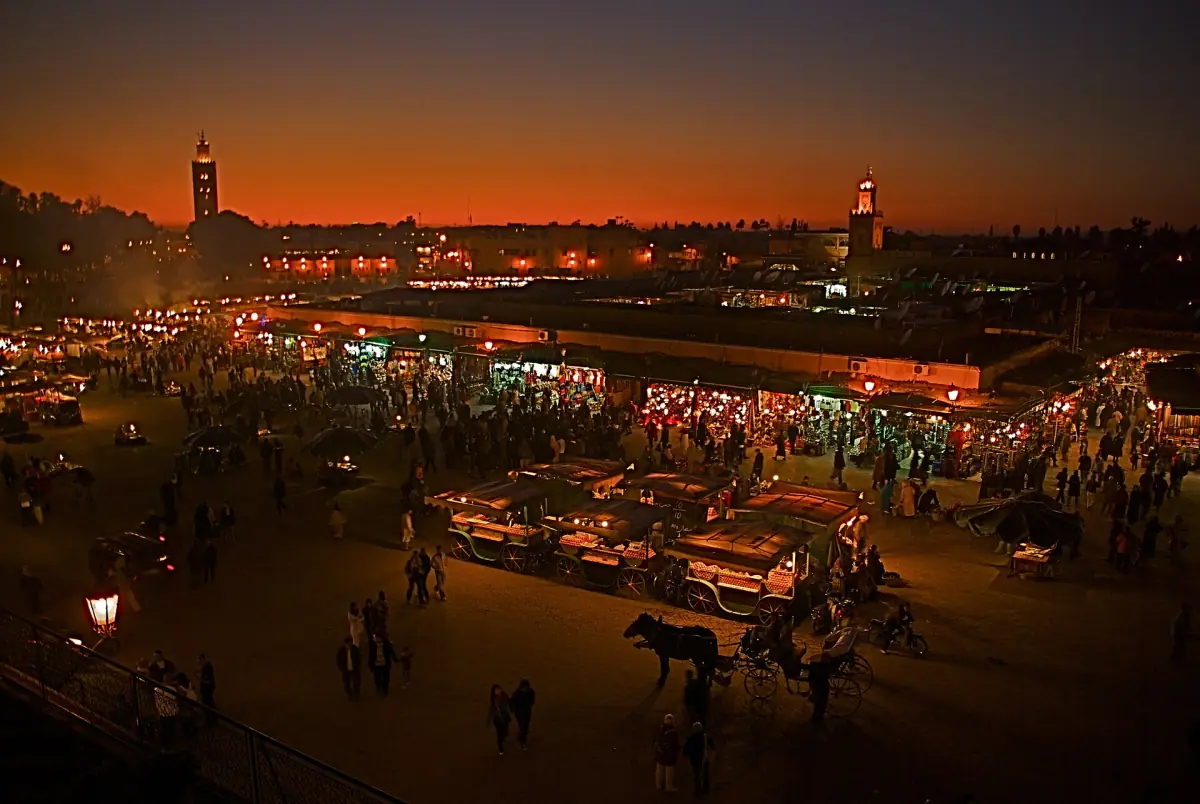
Key facts in a table
Prices are examples for 2026, not fixed rates.
| Topic | What to know |
|---|---|
| Location | Medina of Marrakech, south of the souk network, east of the Koutoubia Mosque |
| Shape | Triangular, at the entrance to the medina |
| Entry | Free for everyone |
| UNESCO | Medina World Heritage 1985; cultural space proclaimed 2001 and listed 2008 |
| Name spellings | Jemaa el-Fna, Jamaa el Fna, Djemaa el Fna: all the same square |
| Busy hours | Late afternoon to late evening, some stalls open past midnight |
| Orange juice | MAD 4 to 5 for a regular glass, MAD 8 to 10 for a large one |
| Main dish at a stall | MAD 40 to 80 as a rough guide |
| Koutoubia minaret | 77 m high |
For most visitors the useful rule is simple: arrive in the late afternoon, walk around once before you sit down, and agree prices before you order.
Our pick: the square after dark
Our take: the evening walk shows how the square changes once the stalls are up.
Hand-picked tours, booked through GetYourGuide. Prices are indicative starting prices in euros (as of October 2026). Tap a tour for live availability and the current price in your currency.
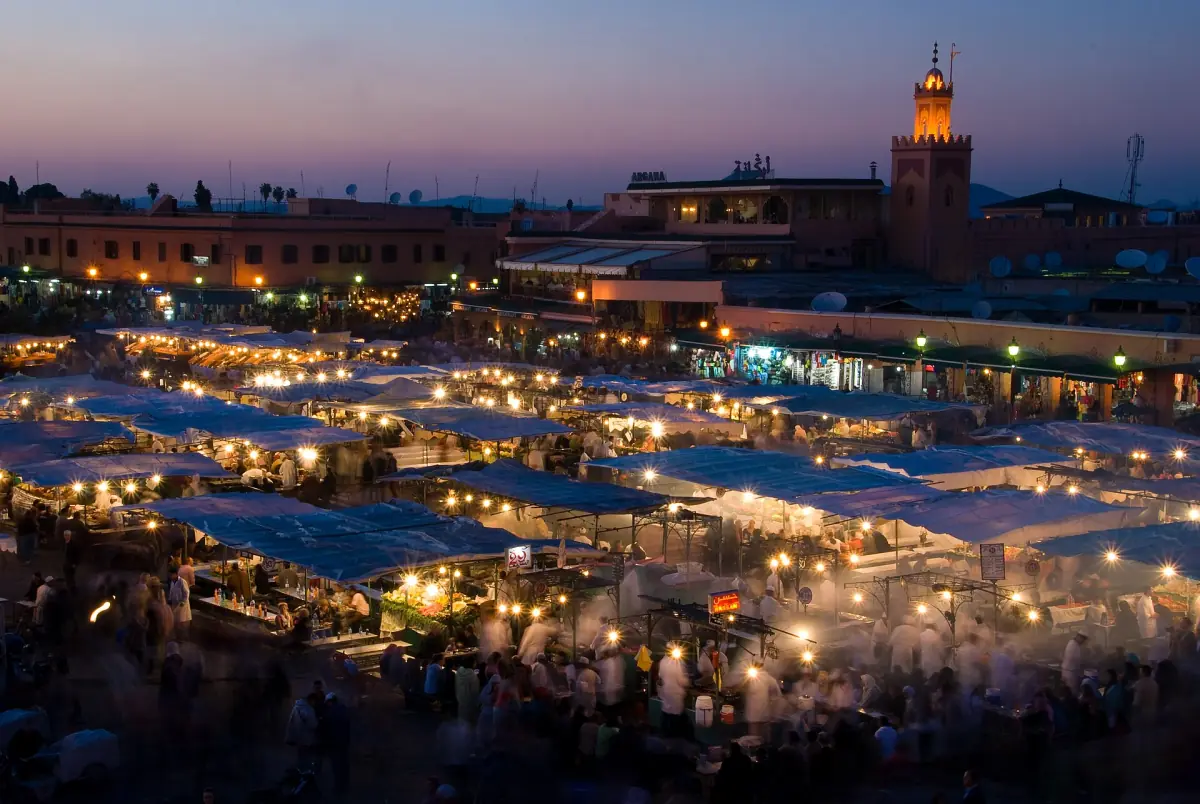
Tours at Jemaa el-Fna
Guided medina walks, food tours and day trips from Marrakech, with live prices and availability.
Daily rhythm of the square
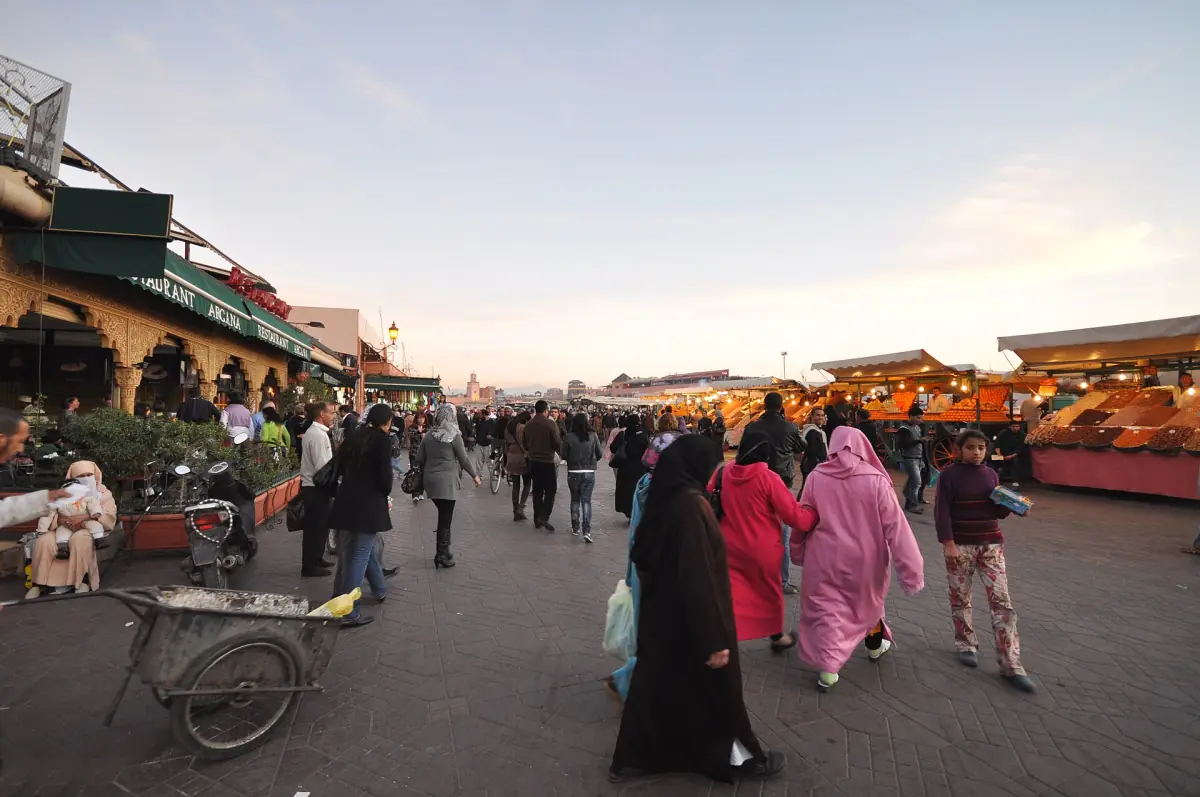
The square changes through the day. Fresh juice is on sale from the morning. In the afternoon the crowd builds, and the square reaches full swing in the evening, when the food stalls and the performers take over.
Times for the evening vary. Stalls start setting up from about 5 p.m. or at sunset. The strongest activity runs roughly from 7 to 11 p.m., and some stalls close around 1 a.m. There is no official opening or closing time for the evening market, so treat these hours as a guide. The page on the square at night explains what to expect, and the history of Jemaa el-Fna covers the heritage listing.
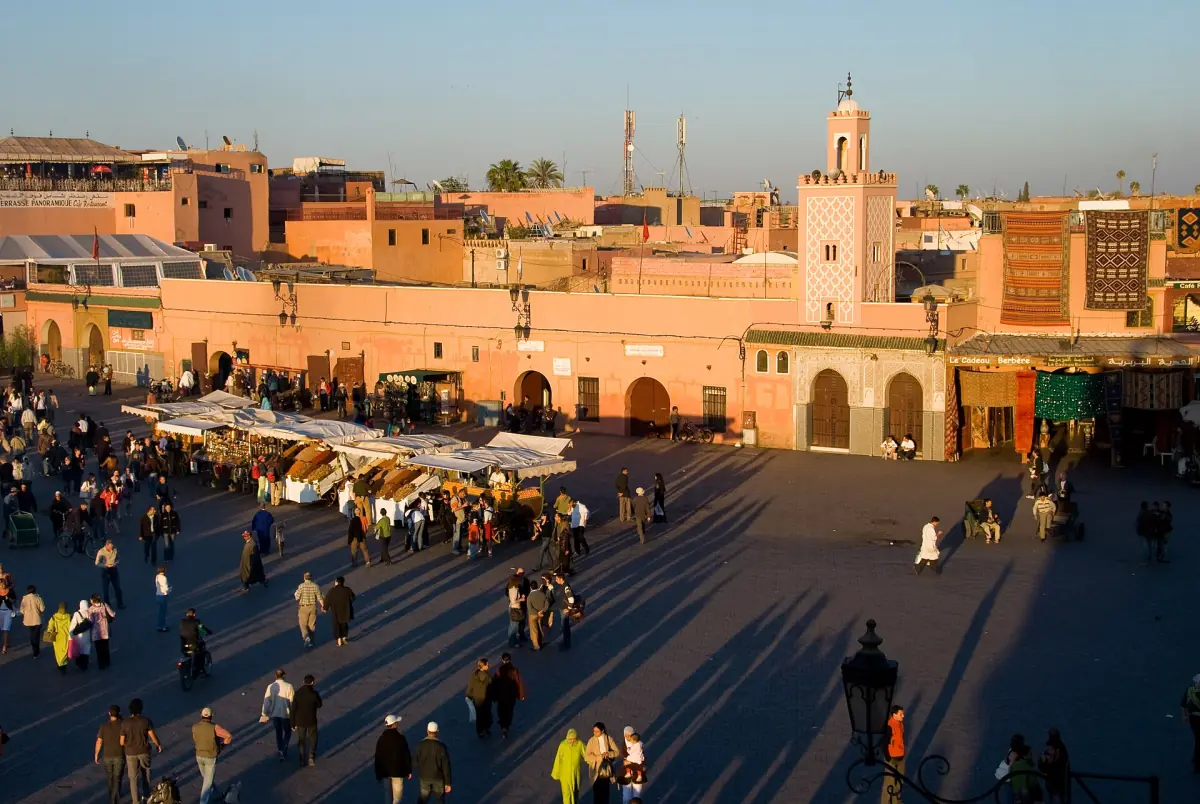
Stalls, numbers and changes
What you can count on, and what you cannot.
Numbered stalls
The food stalls carry visible numbers. The numbering is not in a straight sequence, and the highest number is not the number of stalls.
How many stalls?
Counts range from about 50 to more than 100 active stalls, and the number changes from day to day. Treat any fixed total with caution.
Ongoing renewal
New stall fittings were put out to tender in 2026, and road work around the square continues. Old stall maps may no longer match what you see on site.
Photos and performers
Some performers, such as water carriers, ask MAD 10 to 20 for a photo. That is a request, not an entry fee. Snakes and monkeys are kept on the square for tourist photos. Animal welfare organisations criticise this, and paying for such photos keeps it going.
Heritage status: two separate entries
The medina of Marrakech has been a World Heritage site since 1985. The cultural space of Jemaa el-Fna is a different entry, proclaimed in 2001 and added to the Representative List of intangible heritage in 2008. The second protects practices such as storytelling and music, not a building. The full sequence is on our history page.
The square therefore has no double World Heritage listing. There are two listings, for two different things.
Practical facts for your visit
Small points that save money and time.
Ask before you order
There is no fixed price list for the stalls. Clarify the price and what it covers before you order, and do not assume side dishes that arrive at the table are free.
During Ramadan
Daytime food choice is smaller, and the evening gets busier after the fast is broken. Ramadan 2027 is expected to begin around 8 February, with Eid al-Fitr around 10 March, but the dates depend on the moon sighting.
Names you will see
Maps, tickets and signs spell the name in several ways. If a tour lists Jemaa el-Fna, Jamaa el Fna or Djemaa el Fna as its start, it means this square.
Jemaa el-Fna facts: frequently asked questions
Is there an entrance fee for Jemaa el-Fna?
No. The square is a public space and free to visit. Rooftop terraces, museums and guided tours nearby charge their own prices.
How big is Jemaa el-Fna?
UNESCO describes it as triangular. There is no official measured area, so treat any size figure with caution.
What time does Jemaa el-Fna open?
The square is always open. The food stalls set up from late afternoon, and the busiest hours are about 7 to 11 p.m. Juice sellers work in the morning too.
Is Jemaa el-Fna a World Heritage site?
The medina of Marrakech is, since 1985. The cultural space of the square is listed separately as intangible heritage, proclaimed in 2001 and listed in 2008.
How much does orange juice cost on the square?
A regular glass is typically MAD 4 to 5 and a large glass MAD 8 to 10 in 2026. Ask before you order.
Is this the official Jemaa el-Fna website?
No. This is an independent guide. It is not run by the city of Marrakech, the national tourist office or UNESCO, and it is not connected to any tour operator, riad or hotel.